

What comes to your mind when you hear the word ‘coding’ or ‘programing’?
Do you envision a dude sitting in front of the computer fixated to the screen in the ‘zone’ working into wee hours? Or frustrated with infinite bug loop?
Let me tell you the story about Marina Umaschi Bers that gives you a different view…
Though Marina was trained at MIT Media Lab (MS/PhD) with renowned AI pioneer and computer scientists, she started her career in journalism in Argentina for the love of words. Marina and her team developed KIBO robots for children age 4-7 and ScratchJr, a programing language for children age 8 and up. Currently, she is a professor of Education and Computer Science and leads the DevTech research group at Boston College.
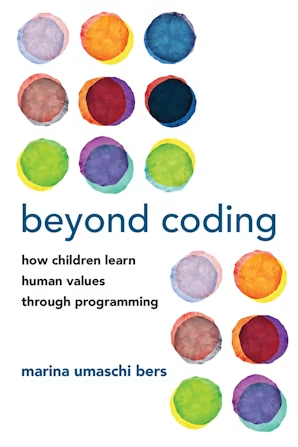
Recently I read her book, Beyond Coding: How Children Learn Human Values Through Programming (The MIT Press).
What struck me about Marina is that on the surface, she is a technologist and a professor, yet deeper down, she is a humanist with the mission to support children build character strength, creativity, and self-expression, and make themselves and the world better through technology and education.
Marina believes coding is another language for human expression, communication, and problem-solving. Marina and her team developed not only tech tools, but also supporting program: curriculum, pedagogy, and trainings to equip and encourage educators as constructionists: setting up a playground for children to explore, to find and solve challenges in their projects, and support others.
Marina calls the character skills ‘palette of virtues’. Like an artist, using her brush to mix this and that color, try here and there, sometime, it works, other times, it doesn’t, and the artist tries again. This happened also in the classrooms. For examples:
In the story about ‘Perseverance’, Marina took us to Josue, a second grader’s world. He enjoyed the class but never created his story until his teacher, Ms. Barnard approached him, first complimented him as a great storyteller, then asked if he would like to create a story with ScratchJr. Josue was unsure, interested to create a very long story but concerned of the program limit and felt it would take a lot of work. His teacher agreed it’d take a lot of work but offered him more tablets so he could create a very long story. She also cheered him each day for small achievements, “Look at the amazing things you can do when you don’t give up!” Josue persisted. It took him two weeks to complete the project. When he showed it to the class, the children cheered along his prince. Josue was so proud and he couldn’t wait to work on a new story. (p.152-155 of Beyond Coding)
In the story about ‘Generosity’, Marina brought us to Mikah, a six years old. She successfully worked with her partner, Javier putting their KIBO robot together to spin and turn. Her teacher, Ms. Tanaka approached her, “Mikah, I noticed that Alexander looked very upset. Would you mind seeing what’s wrong for me?” Mikah agreed, walked to Alexander, and asked…“I tried many times but it didn’t work,” Alexander cried out. His KIBO made an error noise. Mikah thought…and found that Alexander forgot to put the end repeat block so his robot didn’t know when to stop. After adjustment, the robot started turning. Ms. Tanaka could help Alexander herself but she chose to find another child who had the skill to help even though it’d be more time-consuming and riskier if it didn’t work out. It paid off: both Mikah and Alexander were happy not only the robot was turning but also they gave and received help with each other. (p.166-168 of Beyond Coding)
In both stories, it could go the opposite: the children refused to do or help, and teachers also learned to think, cope, and try again. Both teachers and students become artists when painting with virtues through teach ‘n learn.
What do all these mean to you?
If you’re an educator or a parent, have friends or family members with young children, check out Marina’s website. You can read her books, find ScratchJr for free on App Store or Google Play, learn about KIBO robots, and much more.
For all of us, ask yourself what you’re good at, what you care about, and how you can use them to create value for others.
Think about the beneficiaries, multipliers, and key influencers—their motivations and constraints—to construct supporting environment, ecosystem, and tools.
Then get out to practice, refine, and make a difference.
Robotics, coding, and education are Marina’s ways to build heads, hearts, and futures.
What’s yours?
Book Reference: Bers, Marina Umaschi. Beyond Coding: How Children Learn Human Values Through Programming. The MIT Press.
Part of the Growing Up Well series — Building Heads, Hearts, and Futures